Cyprus is one of the most transparent and well-regulated business jurisdictions in Europe. One of the key obligations for companies registered in Cyprus is the annual audit of their financial statements by a licensed independent auditor. However, the requirement for an audit depends on the type and status of the company. Below is a comprehensive overview.
1. General Rule: Almost All Companies in Cyprus Must Be Audited
Under Companies Law, Cap. 113 and the Cyprus Auditing Standards (based on ISA):
All companies registered in Cyprus are required to undergo an annual audit, regardless of:
- size,
- turnover,
- profitability,
- level of activity.
This includes:
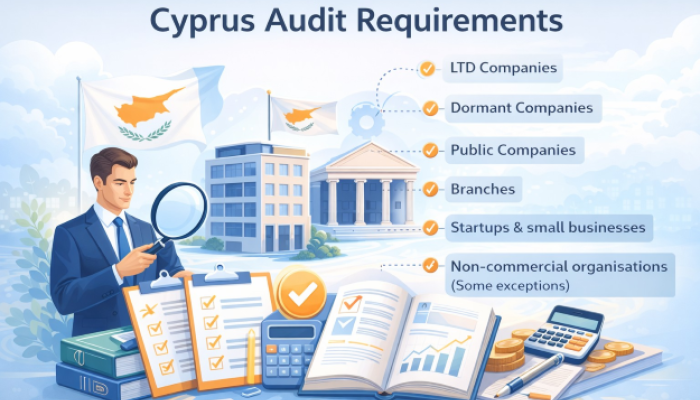
- Private Limited Companies (LTD)
- Public Companies
- Branches of foreign companies
- Group structures and holding companies
- Investment firms, Forex companies, Crypto companies
- Funds, trusts, and companies with foreign beneficiaries
Thus, Cyprus follows a strict model: even a company with no activity (“dormant company”) must file audited financial statements, unless it qualifies for very rare exceptions.
2. Which Companies May Be Exempt From Audit?
There are several exceptions — but they are extremely limited.
2.1. Dormant companies created before 2016
A company may submit unaudited dormant financial statements only if:
- it has been inactive since incorporation,
- has had no transactions,
- no movement in bank accounts.
But:
- if there was even one commercial transaction — an audit becomes mandatory;
- if the company was incorporated after 2016, an audit is required regardless of activity.
2.2. Small companies — in tax filings, but not audit requirements
Cyprus has discussed simplified filing for micro-companies, but: It does not remove the obligation for an annual audit. Even a small startup or one-person company must undergo a full audit.
2.3. Non-commercial organizations not registered as companies
- Associations (Σωματείο),
- Foundations (Ίδρυμα),
- certain public or charitable bodies,
may be exempt depending on structure. But if the organization is registered as a company (LTD) — an audit is mandatory.
3. Companies Required to Undergo Enhanced (Special) Audits
Apart from the standard audit, some businesses fall under stricter obligations.
3.1. Regulated Entities
- CIF / Forex companies (licensed by CySEC),
- AIF / UCITS / Funds,
- Administrative Service Providers (ASP),
- Trustees and fiduciary firms.
They must undergo:
- annual financial audit,
- AML (anti-money laundering) audit,
- compliance audit,
- regulatory reporting.
3.2. Companies exceeding certain thresholds
Companies that surpass specific turnover or asset limits may require:
- consolidated financial statements,
- group audits.
3.3. Companies engaged in international or related-party transactions
If a company is involved in:
- cross-border services,
- related-party transactions,
- transfer pricing activities,
then an audit is mandatory and often significantly more complex.
4. What Does a Statutory Audit Include in Cyprus?
- accounting records,
- banking transactions,
- compliance with Cyprus Companies Law,
- tax compliance and filings,
- substance requirements,
- corporate governance practices.
The audit concludes with:
- Financial Statements
- Audit Report
- Submission to:
- Tax Department
- Registrar of Companies
- Regulatory authorities (if applicable)
5. Consequences of Not Performing an Audit
Penalties can be severe:
- the company cannot file Annual Return (HE32),
- administrative fines accumulate,
- the company may be struck off (removed from register),
- directors may be held legally responsible,
- banks may freeze or close corporate accounts.
6. Summary Table: Who Must Be Audited?
| Company Type | Audit Required? | Notes |
|---|---|---|
| Private LTD | Yes | Mandatory for all |
| Dormant company | Usually yes | Rare exceptions for old dormant companies |
| Public company | Yes | Enhanced requirements |
| Branch of foreign company | Yes | Must audit Cyprus operations |
| Associations (Σωματείο) | Not always | Depends on legal form |
| Regulated entities | Yes | Multiple audits required |
| Funds / investment structures | Yes | Strict regulatory rules |
| Startups / micro companies | Yes | No exemptions |
Conclusion
Cyprus maintains a transparent, internationally aligned auditing framework.
Almost all companies must undergo an annual audit, regardless of their size or level of activity. Exemptions are rare and limited. The audit is a key element of corporate, tax, and regulatory compliance.